Inheritance in Java is a mechanism in which one object acquires all the properties and behaviors of a parent object. It is an important part of OOPs (Object Oriented programming system).
The idea behind inheritance in Java is that you can create new classes that are built upon existing classes. When you inherit from an existing class, you can reuse methods and fields of the parent class. Moreover, you can add new methods and fields in your current class also.
Inheritance represents the IS-A relationship which is also known as a parent-child relationship.
Why use inheritance in java
- For Method Overriding (so runtime polymorphism can be achieved).
- For Code Reusability.
Terms used in Inheritance
- Class: A class is a group of objects which have common properties. It is a template or blueprint from which objects are created.
- Sub Class/Child Class: Subclass is a class which inherits the other class. It is also called a derived class, extended class, or child class.
- Super Class/Parent Class: Superclass is the class from where a subclass inherits the features. It is also called a base class or a parent class.
- Reusability: As the name specifies, reusability is a mechanism which facilitates you to reuse the fields and methods of the existing class when you create a new class. You can use the same fields and methods already defined in the previous class.
The syntax of Java Inheritance:
    class Subclass-name extends Superclass-name
    {
       //methods and fields
    }
The extends keyword indicates that you are making a new class that derives from an existing class. The meaning of “extends” is to increase the functionality.
Java Inheritance Example
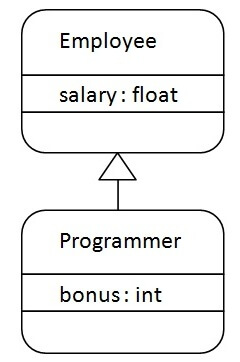
As displayed in the above figure, Programmer is the subclass and Employee is the superclass. The relationship between the two classes is Programmer IS-A Employee. It means that Programmer is a type of Employee.
    class Employee{
     float salary=40000;
    }
    class Programmer extends Employee{
     int bonus=10000;
     public static void main(String args[]){
       Programmer p=new Programmer();
       System.out.println("Programmer salary is:"+p.salary);
       System.out.println("Bonus of Programmer is:"+p.bonus);
    }
    }
Programmer salary is:40000.0
Bonus of programmer is:10000
Types of inheritance in java:
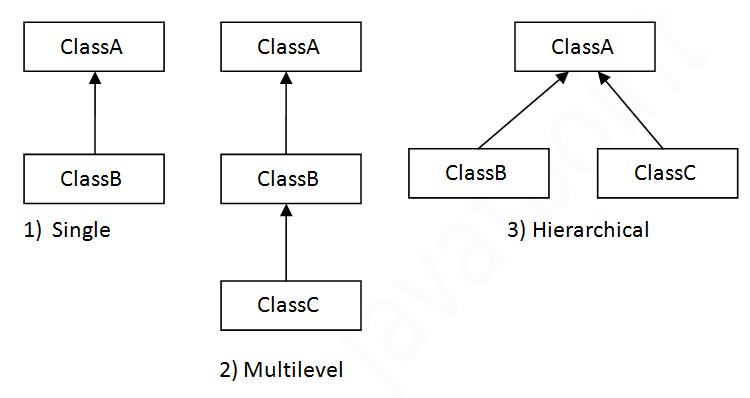
On the basis of class, there can be three types of inheritance in java: single, multilevel and hierarchical.
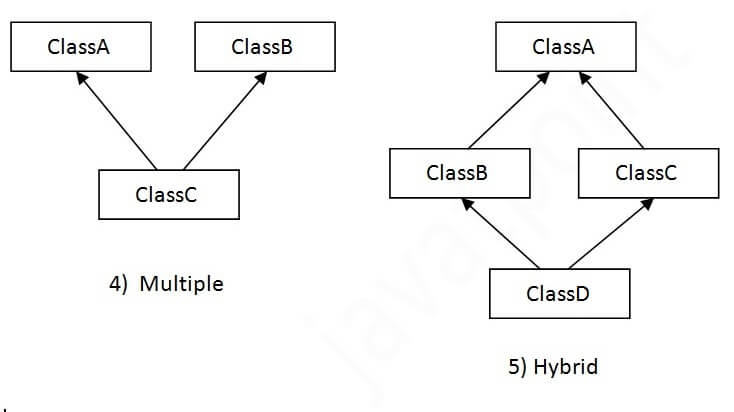
In java programming, multiple and hybrid inheritance is supported through interface only. We will learn about interfaces later.
Note: Multiple inheritance is not supported in Java through class.
When one class inherits multiple classes, it is known as multiple inheritance.
Single Inheritance Example:
When a class inherits another class, it is known as a single inheritance. In the example given below, Dog class inherits the Animal class, so there is the single inheritance.
    class Animal{
    void eat(){System.out.println("eating...");}
    }
    class Dog extends Animal{
    void bark(){System.out.println("barking...");}
    }
    class TestInheritance{
    public static void main(String args[]){
    Dog d=new Dog();
    d.bark();
    d.eat();
    }}
Output:
barking...
eating...
Multilevel Inheritance Example:
When there is a chain of inheritance, it is known as multilevel inheritance. As you can see in the example given below, BabyDog class inherits the Dog class which again inherits the Animal class, so there is a multilevel inheritance.
    class Animal{
    void eat(){System.out.println("eating...");}
    }
    class Dog extends Animal{
    void bark(){System.out.println("barking...");}
    }
    class BabyDog extends Dog{
    void weep(){System.out.println("weeping...");}
    }
    class TestInheritance2{
    public static void main(String args[]){
    BabyDog d=new BabyDog();
    d.weep();
    d.bark();
    d.eat();
    }}
Output:
weeping...
barking...
eating...
Hierarchical Inheritance Example:
When two or more classes inherits a single class, it is known as hierarchical inheritance. In the example given below, Dog and Cat classes inherits the Animal class, so there is hierarchical inheritance.
    class Animal{
    void eat(){System.out.println("eating...");}
    }
    class Dog extends Animal{
    void bark(){System.out.println("barking...");}
    }
    class Cat extends Animal{
    void meow(){System.out.println("meowing...");}
    }
    class TestInheritance3{
    public static void main(String args[]){
    Cat c=new Cat();
    c.meow();
    c.eat();
    //c.bark();//C.T.Error
    }}
Output:
meowing...
eating...
Hybrid inheritance in java:
Hybrid Inheritance is a combination of both Single Inheritance and Multiple Inheritance. Since in Java Multiple Inheritance is not supported directly we can achieve Hybrid inheritance also through Interfaces only.

As we can see in the above diagram ClassA is the Parent for both ClassB and ClassC which is Single Inheritance and again ClassB and ClassC again act as Parent for ClassC(Multiple Inheritance which is not supported by Java). Lets now see below code on what will happen if we go for implementing Hybrid Inheritance with both classes and interfaces.
Implementation of Hybrid Inheritance with Classes:
public class ClassA
{
    public void dispA()
    {
        System.out.println("disp() method of ClassA");
    }
}
public class ClassB extends ClassA
{
    public void show()
    {
        System.out.println("show() method of ClassB");
    }
    public void dispB()
    {
        System.out.println("disp() method of ClassB");
    }
}
public class ClassC extends ClassA
{
    public void show()
    {
        System.out.println("show() method of ClassC");
    }
    public void dispC()
    {
        System.out.println("disp() method of ClassC");
    }
}
public class ClassD extends ClassB,ClassC
{
    public void dispD()
    {
        System.out.println("disp() method of ClassD");
    }
    public static void main(String args[])
    {
          ClassD d = new ClassD();
          d.dispD();
          d.show();//Confusion happens here which show method to call
    }
}

OUTPUT :

Error!!
 Site Title